The morning claimed her before the clock could. It was an unfortunate precision, stripping away those precious few minutes during which she might have blamed something outside herself for the burden of consciousness.
Beside the bed, the alarm clock rested on its little table, its red digits glowing with the patient, cold hostility of a low-ranking bureaucrat who had already stamped her application REJECTED before she had even crossed the threshold. She would lie rigid beneath the heavy blanket, watching the brutal arithmetic of the display.
6:12.
6:13.
6:14.
At 6:15, the mechanism shrieked. She silenced it with a single motion, then rose.
There was a dull, mechanical sequence to it all, and perhaps that was what rotted beneath the surface. She could have been replaced by an assembly of iron levers and a spring-loaded hand, and her mother, clattering about in the kitchen, would not have noticed the substitution.
The floorboards were cold. The kettle was cold. The entire concrete box of the apartment was cold, though the calendar insisted it was peak summer.
She washed her face in lukewarm water, dressed, drank tea that tasted faintly of lead, and stepped out into the damp public stairwell to begin her commute.
Every day was laid out like a slab in a morgue. Minor variations occurred, of course; a bus delayed by a stall, a customer spitting threats over a counter. Once, a bloated pigeon rattled into the office through an open pane and hammered its skull against the water-stained ceiling with such frantic, blind determination that several clerks stood motionless, watching its agony for nearly ten minutes. But the geometry of existence remained absolute.
She woke. She travelled. She worked. She returned.
Her mother would ask if she had eaten. Her father asked nothing at all. At night, her mind dragged her through endless fields of rain. She kept this to herself. Not out of modesty or secretiveness, but because experience had taught her the quiet law of the human hearth: people are immensely relieved when you keep your decay to yourself. They prefer you fun or mute. A person who suffers without making a sound is not necessarily loved, but she is, at the very least, convenient.
In the office, she processed messages and smoothed over paper trails left behind by careless hands. Her vocation was the quiet erasure of other people's mistakes, leaving no seam or smudge to suggest an error had ever existed. She was remarkably good at it.
“Thank you,” her supervisor said one afternoon.
She looked up, but he was already moving down the corridor, his shadow stretching across the linoleum. For a moment, she wondered if the words had actually been spoken or merely hallucinated. Eventually, she decided he must have said them.
That evening, the television set was left burning in the living room, babbling into the stale air while her mother chopped root vegetables in the kitchen. On the screen, a woman wept hysterically without sound; three men in cheap suits sat in a semicircle, debating the cause of her tears. Her father remained motionless in his armchair, his swollen hands folded over his stomach like weight on a corpse.
She slipped her shoes off at the door.
“You're late,” her mother called.
“The bus.”
“Again?”
“Yes.”
A heavy, wet sigh drifted from the kitchen. It carried no anger, which made it feel far more suffocating. In the armchair, her father’s dull eyes shifted toward her.
“Did you hear from him?”
The rhythm of the kitchen knife snapped shut. Her mother froze, staring down at the wooden board. Everyone in the apartment knew who him was supposed to mean.
The brother.
She had heard nothing. She never heard from him, not since that day. And whenever someone asked, something deep inside her stomach coiled with the sour, exhausted irritation of a suspect being dragged back into an interrogation room for a crime committed a lifetime ago, the details of which had long since dissolved.
“No,” she said.
Her father gave a single, slow nod. The knife began its rhythmic thud against the wood once more. On the screen, the woman continued to cry.
After a long pause, her mother spoke to the wall. “You should try calling.”
She stared at her mother's curved back. Her mother turned, her face pinched with a clumsy, dull confusion.
“Calling again?”
For several seconds, the apartment was entirely silent save for the hum of the television tube. Her father turned his gaze back to the glowing screen. Her mother picked up another pale piece of carrot and set it beneath the blade.
“Forget it,” she said.
She withdrew to her small room. That night, the dream returned, thick with rain. She was standing in a forest, or what her mind insisted was a forest. Dark, vertical trunks rose around her, their tops swallowed by a dense, grey mist that erased the sky. The bark was black, saturated with water. Beneath her bare soles, the earth felt thick, bloated, and wet.
She remembered thinking that her skin ought to be freezing, but the cold did not come. Instead, the air carried a smell of something sweet and stifling. Like damp flour mixed with ancient honey.
She began to walk. The mud sucked at her ankles with a wet, rhythmic drag. Each step resonated through the quiet woods like a heavy weight dropping into sludge. Ahead, framed by the dead trees, stood the mouth of a cave. It made no effort to conceal itself, and that was its primary terror. It sat among the timber as casually as a doorway in an abandoned tenement. A terrible realization crept over her: she had walked past this gaping maw a hundred times before, and it had simply waited, patient as iron, for her to notice it.
The opening was absolute pitch. Rain poured over the slick, grey stone above it. She took a step closer, then stopped. Something pale lay twisted in the weeds to her left. At first, she mistook it for a dead animal. Then, a pale, waterlogged human shape emerged from the gloom. The rain ran in rivulets across its bare skin. It lay face down in the mud. One arm was pinned beneath the torso at an impossible, broken angle—not gory, precisely, but fundamentally wrong. As if the body had simply grown tired and fallen asleep while trying to drag itself toward the dark.
An unbearable urge pulled her toward the figure.
The mouth of the cave called to her...
She woke with her jaw locked so hard her teeth ached. The electronic alarm was screaming.
6:15.
She remained motionless for a few minutes. Yesterday’s clothes sat draped over the wooden chair like a shed skin. Her tea cup sat on the table. The heavy curtains remained drawn. Everything was in its proper, miserable place. And yet, the back of her throat still tasted of wet flour and old honey.
At work, her hand slipped, sending a dark wave of tea cascading over a stack of fresh reports. Her supervisor stood over her desk, watching the liquid drip onto the floorboards. She murmured an apology.
“You seem distracted lately.”
“I didn't sleep.”
“Again?”
She turned her gaze up to his face. He knit his brows. With a sudden, embarrassing prickle of shame, she realized she had been staring blankly into his eyes for far too long.
“Sorry.”
He dismissed it with a tired wave of his hand.
“Go outside for a minute.”
“I quit smoking.”
“I didn't say smoke.”
“Oh.”
He let out a short breath. She went down the concrete stairs and out the rear exit. It was not raining, though the sky looked heavy enough to collapse. She found him sitting on the low concrete retaining wall behind the building, looking entirely unbothered by her presence, as if her arrival were an entry in a ledger he had already signed off on.
“You look terrible,” he said.
“Thank you.”
“You know what I mean.”
“No, I don't.”
He shifted his weight, clearing a patch of cold stone beside him. She sat down. For a long while, they sat watching the heavy grey automobiles crawl along the boulevard. There was an eerie, drafty comfort in his presence; silence between them did not curdle into a demand.
Finally, he spoke to the asphalt. “The cave again?”
She stiffened, turning to look at his profile. She had no recollection of telling him about the dream. Or perhaps she had. Yes, she must have.
“It's getting closer,” she said.
He nodded once, his eyes fixed on the traffic.
“That happens.”
“What does?”
“When you stop pretending you don't know where you are.”
She waited for the rest, but it did not come. A faint, bitter curve touched his lips before he looked away toward the grey buildings opposite them. She did not press him. He did not ask why she refrained.
She cleared her throat. “There's someone in the forest.”
He ran a calloused thumb across the palm of his other hand.
“A person?”
“I think so.”
“You didn't look?”
“No.”
“Why not?”
“The cave.”
He gave another small nod.
“Yes.”
“Yes?”
“I know.”
A sudden panic flickered in her chest—she wanted to demand what he meant, what he knew, what he was keeping from her.
Instead, she merely said, “I don't want to go back.”
He let out a quiet, breathy laugh. It was utterly devoid of malice, which made it far harder to bear.
“I know,” he said.
He let the silence stretch until the air felt brittle, then added, “But you always do.”
When she unlocked the door to the apartment that evening, her mother was waiting in the narrow corridor. Her face was twisted into an expression that hovered unsteadily between raw fury and terror; two states that, in certain households, were entirely indistinguishable.
“Where were you?”
“Work.”
“Don't lie to me.”
She stood frozen on the doormat. Behind her mother, her father sat shadowed at the kitchen table, an motionless silhouette.
“What?”
“You disappeared again.”
The word hit her like a physical blow. A sharp, ugly sound escaped her throat... a laugh that tasted like long accumulating illness.
“Again?”
Her mother’s lips pressed into a thin, white line.
“You know exactly what I mean.”
“No,” she said. “I don't.”
“You do this. You disappear into that room and you don't answer, and then you act as if—”
“As if what?”
The sentence hung in the air. Her father stood up slowly from the table.
“Enough.”
“No,” her mother snapped, her voice rising to a thin shriek. “No. She should hear it.”
Hear what? she wanted to scream. But a sudden, crushing fatigue settled into her limbs. It was not the tiredness of an argument, but a deep, physical exhaustion, as if she had just completed a ten-mile march through knee-deep mud. Her mother stared at her, and the anger on her face suddenly buckled. The features collapsed inward. For one horrifying second, her mother’s eyes washed over her, looking entirely through her, as if staring at an empty corner of the room.
Then her mother whispered, “I'm sorry.”
Her father reached out, resting a heavy hand on his wife's shoulder. “Come on.”
She shoved his hand away with a jerk of her frame. “No.”
Her eyes locked back onto her daughter.
“Where is your brother?”
She opened her mouth, but her throat had gone bone-dry. Her father uttered her brother's name into the quiet apartment. It was a name she had lived alongside her entire life. She knew she had. But as she tried to grasp the syllables in her mind, they dissolved, slipping through her memory like a whisper beneath deep water.
Late that night, she sat on the edge of her mattress and dialed the telephone.
“You're awake,” she said into the receiver.
“I knew you'd call.”
“Don't sound pleased.”
“I'm not.”
“You are.”
“Maybe.”
She sank back onto the flat pillow, pressing the cold plastic of the earpiece tight against her ear.
“Do you remember his name?”
A long, hollow pause hummed over the wire.
“Your brother?”
“Yes.”
The static hissed in the background.
“Do you?” he asked softly.
She closed her eyes against the darkness of her room.
“No.”
“That's strange.”
“Yes.”
“Maybe you never knew it.”
“Don't be stupid.”
“Maybe you never knew anything.”
Her fingers tightened on the receiver; she nearly slammed it down onto the cradle. Then the sound of his slow breathing filled the line, and she knew, with terrifying certainty, that he was smiling in the dark. She felt her own lips stretch into the same hollow shape.
“You're horrible.”
“I know.”
“I hate you.”
“No, you—”
The line cut out. The sentence was left severed, hanging over the abyss. Neither of them attempted to fix it. They remained on the dead connection for a long time, until the low hiss of static began to alter its pitch, transforming slowly into the sound of heavy rain.
It was not the rain outside.
She knew this because she could feel the mist settling on her exposed skin. She opened her eyes. Thick, black water was pouring down the peeling wallpaper of her bedroom. The concrete ceiling had rotted away entirely, replaced by a canopy of bare, weeping branches.
She sat bolt upright. The telephone in her grip was cold and dead as a stone. Outside her window, standing directly between the gray concrete blocks of the surrounding apartment complexes, the black woods had taken root. The entrance of the cave sat open among the dead trees.
This time, the pitch-black darkness of the threshold had retreated. Pale skin gleamed in the mud at its mouth, waiting patiently for her to remember why she had left it behind.
She did not wake when the alarm began to ring. Somewhere beyond the rain, beyond the black trunks of the forest and the wet earth that clung between her toes, a small mechanical sound repeated itself with the hopeless persistence of an insect trapped beneath glass, but she could no longer understand what waking was supposed to mean. The forest had swallowed the room without destroying it; this was somehow worse. For an instant she could still see the outline of her bed between the trees, the shape of the curtains moving where no window remained, the pale square of her bedroom door standing upright among the roots, and then the rain struck harder and all of it dissolved. She stood alone in a clearing that had not been there before, except for the man behind her and the body lying ahead. Water ran over the naked figure in narrow streams, carrying soil from its shoulders and hips, exposing patches of colourless skin beneath the mud. The body was not arranged like a corpse prepared for burial. It had been abandoned in the posture of something interrupted. One arm was twisted beneath the chest. The other stretched toward the cave, fingers half-buried in the soaked ground, their nails broken and packed with black earth. There was something unbearable in that reaching hand. It suggested effort... that even after the body had ceased to belong to the person who had inhabited it, some last blind instinct had continued to drag it toward the darkness.
She knew she should not approach it. The knowledge arrived without explanation, as ancient prohibitions sometimes do: do not answer a voice from the woods, do not eat what is offered by a stranger after sunset, do not follow the dead if they know your name. But the cave was calling to her, and the body was between her and its mouth. She could hear water moving somewhere inside the stone, although the sound was too rhythmic to be a stream. It seemed to rise and fall like breathing. The man had stopped several paces behind her. She could feel his attention against her back, heavy and patient, and when she turned she saw that rain had washed the colour from his face until he appeared less like a living person than an old photograph left for years beneath water.
She opened her mouth to call him, then froze. She did not know what to call him. The realization was so small at first that she almost laughed. She searched for his name among the memories of their conversations, among the benches and corridors and anonymous cafés where they had sat together, but every memory began in the middle. There was always a pause before he spoke. Always the sense that he had already been waiting. She remembered telling him things she had never told anyone. She remembered his understanding before she had finished a sentence. She remembered him saying I know. She remembered hating him for knowing. But there had never been a first meeting. There had never been an introduction. His name was absent from every memory because there was no place in those memories where it could have been.
“You don't remember,” he said.
His voice did not come from where he stood. It seemed to come from the wet earth, from beneath the leaves, from somewhere behind her eyes.
She turned back toward the body. “What did you do?”
For a long time, the man said nothing. The rain moved between them in silver sheets. Then, with a tiredness that frightened her more than anger would have, he answered, “I thought I had gotten rid of you.”
The forest changed.
It did not move visibly, but the world around her suddenly acquired a second shape beneath the first, as though the rain had washed away a layer of paint. The clearing became smaller. The cave seemed farther away and much older. The ground beneath the body was not smooth soil but a place that had been disturbed and disturbed again, clawed open, pressed down, covered, and reopened by weather and animals and time. Her stomach turned. She crouched beside the naked figure and stared at the back of its head. Ashy hair. Her hair. The same uneven line where she had once cut it herself because she had been too impatient to make an appointment. A scar near the shoulder, small and white, which she remembered receiving when she was a child. The body had become a collection of facts. Each one was impossible alone. Together, they formed a truth so simple that her mind refused it.
“No,” she whispered.
The man's face tightened.
“No,” she said again.
She reached for the body and rolled it over. The scream that came from her was swallowed immediately by the forest. Rain struck the dead woman's face. Her face.
Not the face she knew from mirrors, because mirrors were merciful things. This face had not been allowed to change with her. It had remained where he left it. One side was swollen beneath the discolouration of old injury, the features distorted by rain and earth and time until recognition came only through details too intimate to deny: the slight bend of the nose, the small pale mark beneath the chin, the shape of the mouth. Her mouth. Her eyes stared in different directions. One had been left half-open, clouded beneath a film of rainwater. In it she saw the forest reflected upside down.
Then memory entered her. The forest turned sideways.
She remembered lying on the ground and hearing him breathe above her. She remembered trying to speak and discovering that her body had become distant and disobedient. She remembered him kneeling beside her, saying her name over and over.
After that came the dragging.
She felt it now with such force that her hands went to her throat. She remembered branches scraping against her skin, stones catching beneath her back, wet leaves entering her hair. She remembered his hands beneath her arms, his breath breaking with panic, his voice begging her to wake up even after she no longer could. She remembered him trying to bury her, because terror had reduced him to the most primitive thought available:
hide it, hide it, hide it!
The hole was too shallow. The ground was too wet. He had returned. Covered her again. Returned again. And when the days passed and the smell became impossible and the forest began to feel inhabited by something watching him, he had dragged her toward the cave. There, something had found him first. The man began to cry.
It was the first living sound she had heard since entering the forest, and for one terrible moment she felt sorry for him. She saw the frightened, exhausted person he must have been, filthy with rain and mud, unable to abandon what he had done and unable to undo it. Then she saw his hands. She remembered those hands. Her pity died.
“You killed me.”
“I know.”
“You were with me.”
“I know.”
“All this time.”
His mouth trembled.
“I didn't know how to leave.”
She stood. The dead woman remained at her feet, staring blindly into the rain.
“You don't get to stay.”
The man looked toward the cave.
“No,” he said. “I don't.”
The cave answered. Something inside laughed. The sound resembled an old woman whining. She turned. At first she saw only darkness. Then, far within the mouth of the cave, two pale points opened. The eyes were low to the ground. An old woman was crouching there.
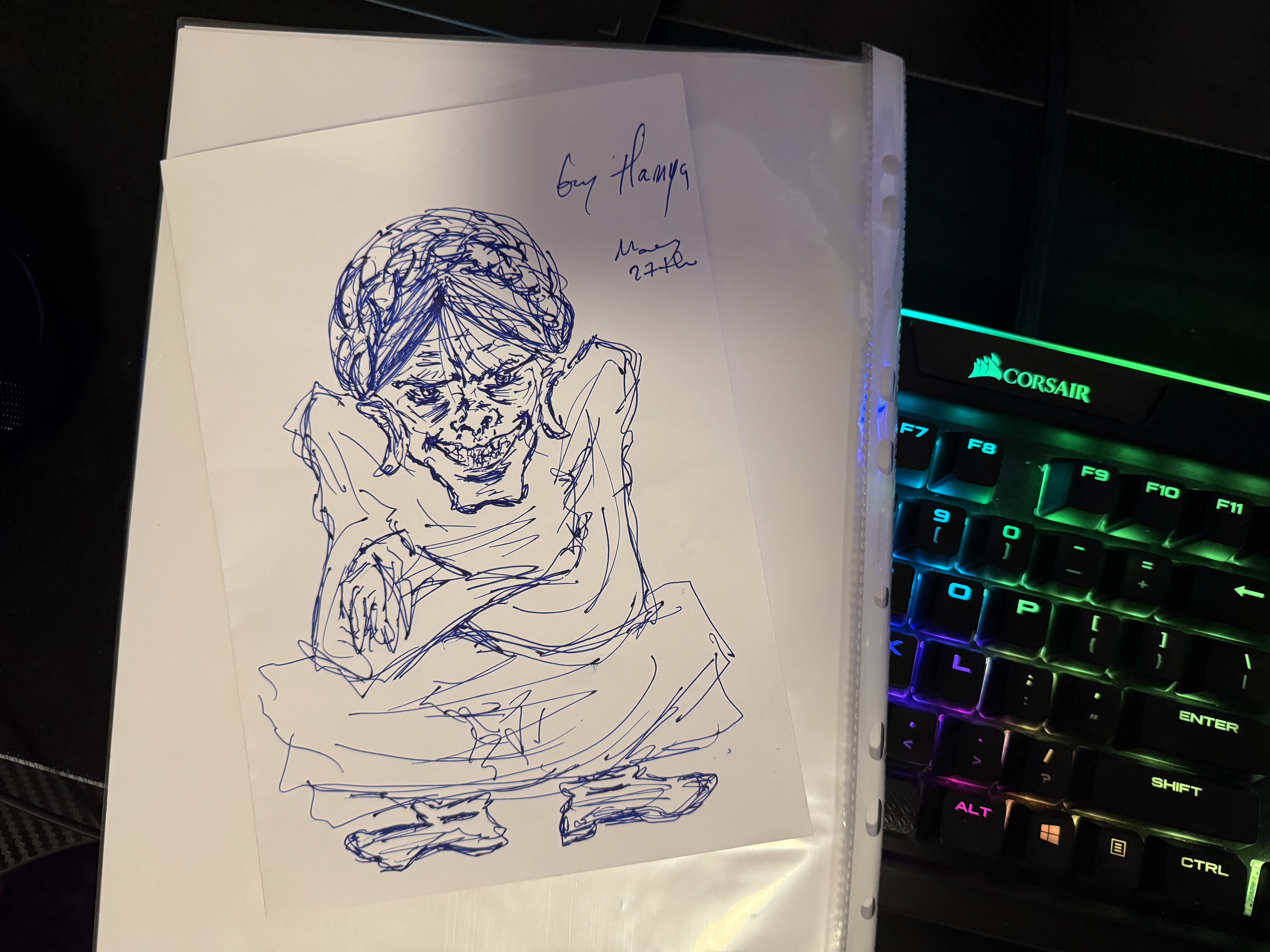
No... she had been crouching there for so long that the forest had begun to grow around her. Her spine rose sharply beneath a garment made from layers of old cloth, roots, and something that might once have been human hair. Her arms were long. Her fingers rested against the stone, yellow nails curved inward like the claws of some burrowing animal. The face was almost hidden beneath a mane of grey hair soaked dark by the damp, but the mouth was visible. It was too wide, and inside it the teeth were not arranged as teeth should be. Some were long. Some small. Some appeared to belong to different creatures.
The woman stepped forward. Her knees bent backward. The dead girl tried to run. Her feet would not move.
The old woman inhaled deeply, and the sound travelled through the cave like wind through a chimney. She smelled of smoke and old soup, and the cold interior of graves. But beneath all of it was the smell of a kitchen. A place where nothing was wasted because everything eventually became food.
“You came back,” Baba Yaga said.
Her voice was not one voice. It contained the dry whisper of an old woman, the croak of a raven, the sound of her mother's television speaking in another room.
The girl could not answer. Baba Yaga tilted her head.
“You brought what was mine.”
The girl looked down at her body.
“I didn't—”
“You did.”
The old woman smiled.
“You always do.”
That woman had been assembled from memory because memory could not bear emptiness. The cave had been calling what remained beneath her. The thing abandoned in the forest. The body that had been hidden but never buried. The dead did not become free because the living stopped saying their names. Sometimes they became thinner. Sometimes they wandered. Sometimes, when every person who loved them began to remember them incorrectly, they built themselves a life from the scraps.
And her brother... The realization hollowed her. Life continued with a cruelty so ordinary that no one noticed it happening. Kin was calling kin.
Baba Yaga extended one hand.
“Come.”
The man seized her arm. She turned to him. His fingers passed through her rotting skin. He looked afraid.
“I can't go in there,” he whispered.
She stared at him. The cave was behind them. The old woman waited.
“You're dead too,” she said.
He closed his eyes. The rain washed down his face...
The girl bent down. She slipped her arms beneath her own corpse. The weight nearly pulled her into the mud. Behind her, the man began to sob. Together they lifted the body. He took the legs. She carried the shoulders. They walked toward the cave. Baba Yaga stepped aside.
The threshold was warm, thick with the heavy stench of lard, marsh peat, and rendered marrow. The boiling sound came from a massive iron cauldron suspended over a bed of silent coals that flickered with a blue, tallow-fed light. Beside it stood a pestle carved from dark oak, stained almost black around the base, and a mortar large enough to hold a grown man upright.
“On the stone,” the old woman commanded. “Lay it flat. Do not let the mud touch the grease.”
They lowered the remains onto a broad slate slab that sloped gently toward a trough carved into the floor. The body was cold, the flesh grey and purple, and rubbery, slick with peat-water. Up close, the memory of her own face was terrifyingly wrong.
Baba Yaga rolled up her sleeves. Her arms were lean, cords of gray muscle binding bone like dried sinew wrapped around a stick.
“A debt is a debt,” she muttered, reaching into her own throat.
The girl gasped, freezing in place. The old woman did not flinch as her hooked, yellow fingers disappeared past her lips. There was a wet, tearing sound, like a boot pulling free from deep clay. Baba Yaga’s jaw unhinged with a sharp snap that echoed off the cave walls. She withdrew her own tongue. It came away with a dry, fibrous root attached at the base, dark and glistening with black bile. She tossed the tongue into the mortar without a backward glance. It thudded softly against the stone.
“A piece of the host to bind the meal,” Baba Yaga rasped. Her voice was flat now, hollowed out, missing its resonance without the organ inside her mouth, yet the words formed clearly in the cold air. Next came her own left ear: she pinched the cartilage near the skull and twisted until the gristle groaned and popped, tearing it away with a spray of thick, black-red jelly. She spat on the slab, wiped her bloody palm down her apron, and seized the heavy wooden pestle.
Crack. The sound was blinding. She brought the pestle down directly onto the dead girl’s ribcage. Bones splintered like dried kindling. Crack and smash!
“Nothing to the crows,” the old woman chanted, her cadence ancient, the rhythm of women thrashing flax in the autumn fields. “Nothing to the worms. What was taken from the dirt returns through the belly. Bodies forgotten, bodies unburied, graves unmarked... all of it belongs to me.”
She worked with horrifying efficiency. Her arms moved in a blur of terrifying strength. She shattered the femur with two clean blows, using her thumbs to scoop out the pale, jelly-like marrow directly into the bubbling pot. The man backed into the cave wall, his phantom hands pressed against his ears, but the sound was inescapable: the wet squelch of rending tissue, the heavy thud of stone pulverizing cartilage, the perpetual grind of bone meal being worked in the mortar.
When the girl’s flesh was peeled back in long, dark ribbons, Baba Yaga did not throw it away. She lifted a strip of dry, leathery skin to her sunken mouth. Her jaw worked back and forth, grinding down with yellowed molars that creaked under the pressure. Crunch. Gulp.
She ate the remnants of the false life: the skin built from inaccurate memories, the stray threads of love that had curdled into regret. She ate the hair, chewing it into thick grey cuds before swallowing. She drank the dark puddle that collected in the slate trough, lapping it up with her toothless gums where her tongue used to be, her chin dripping with dark grease.
The girl watched, unable to look away, as the shape that had carried her name was dismantled down to nothing. Every fragment of hair, every splinter of shinned bone, every drop of rancid fat was swept into the cauldron or worked into the jaw of the old woman.
When the slate was dry, scraped clean by fingernails worn down to the quick, Baba Yaga turned to them. Her mouth was a dark, wet crater. Her chest heaved. She reached into the bubbling pot with her bare, scalded hand, unfazed by the steam, and pulled out a single, smooth object. It was small, no bigger than a plum, shining like polished horn under the blue light of the embers. She held it out to the woman.
“Take what is left,” the old woman croaked from deep within her stomach. “It is light enough to carry now. Go back to your kin and rest in peace, you poor soul.”